Planning 10,000 Vapi Campaign Calls: What the New Docs Reveal
What this guide answers
A campaign-specific review of Vapi's rebuilt outbound product: its real 10,000-contact capability, shared concurrency, pre-dial checks, pricing layers, and campaign results.
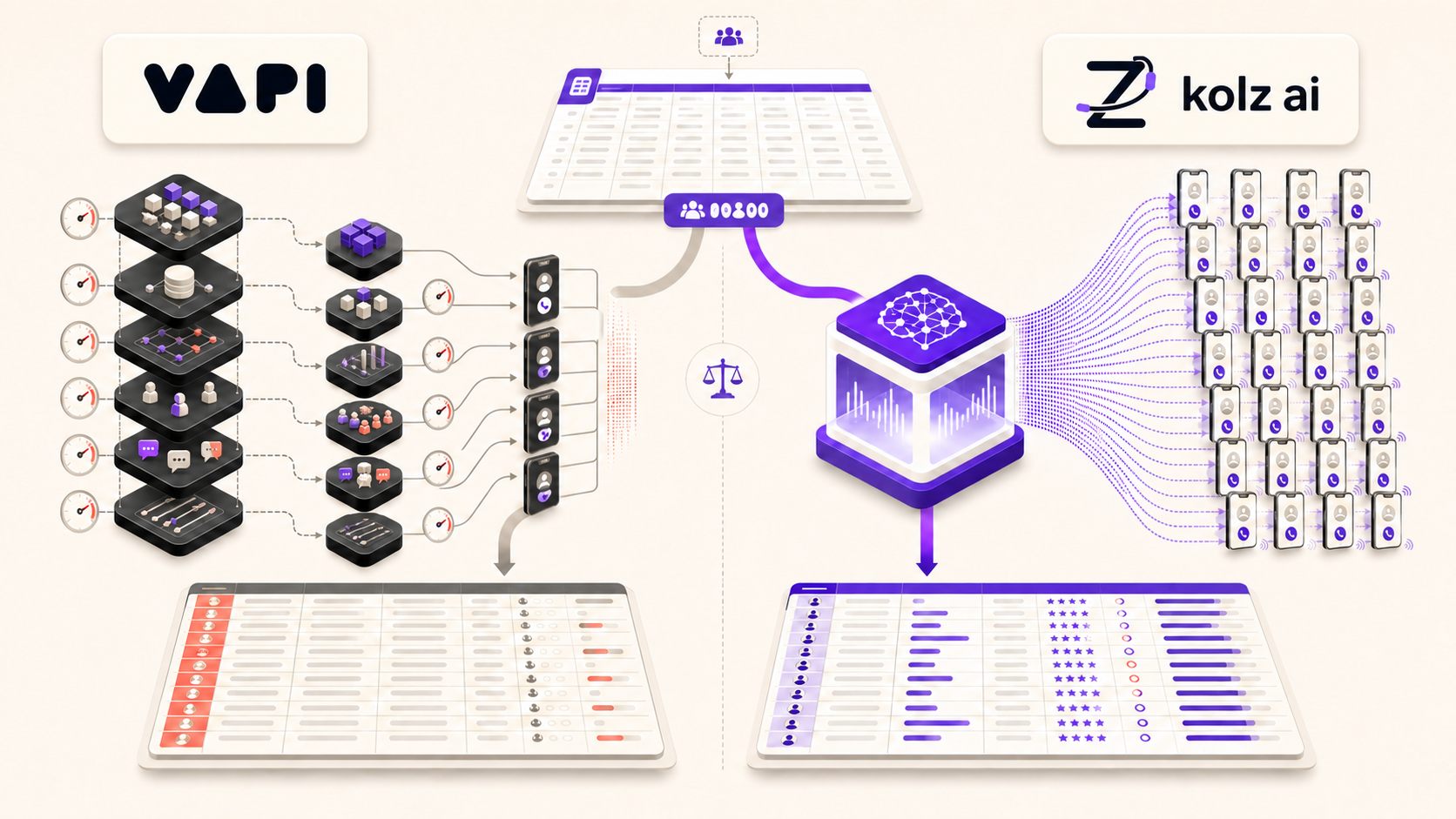
Vapi has rebuilt Campaigns around a clear promise: upload as many as 10,000 contacts, choose an assistant or squad and a phone number, and let the campaign work through the list.
The new product is more capable than Vapi's original 2025 release. We reviewed the Campaigns documentation itself—not generic batch-calling assumptions—to answer the question operators actually have: what happens after you upload 10,000 contacts?
What the rebuilt Vapi Campaigns gets right
Vapi now owns the queue. A campaign can accept the full 10,000-contact CSV, personalize calls with row-level variables, dial inside a defined window, and show every contact moving through pending, dispatched, completed, failed, skipped, or pre-dial-failed states.
That is a meaningful upgrade. Teams no longer need to split the CSV into 50–100-contact files to use the Campaigns product.
A 10,000-contact list is not 10,000-call capacity
Vapi's Campaign API defaults maxConcurrency to 10. More importantly, that number cannot exceed the organization's available call concurrency. Campaigns share the same pool with every other inbound and outbound call.
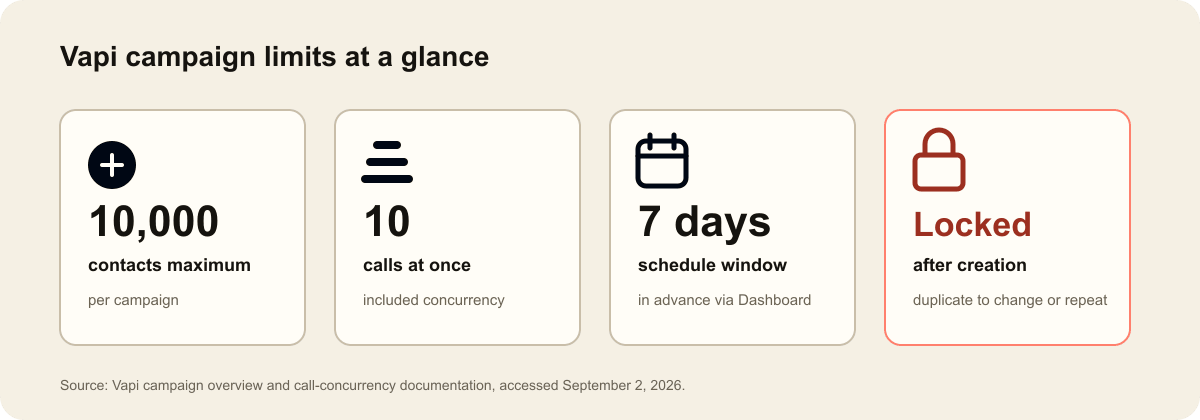
Setting a campaign to 100 does not create 100 call slots. On Vapi Build, the organization must purchase the additional capacity at $10 per call line per month. Configuration is also locked after creation; changing or repeating the run means duplicating the campaign.
For 10,000 calls averaging three minutes, the theoretical dispatch floor is 50 hours at 10 concurrent calls, 10 hours at 50, and five hours at 100. Real runs may take longer because other calls share capacity, call lengths vary, and scheduling windows can close.
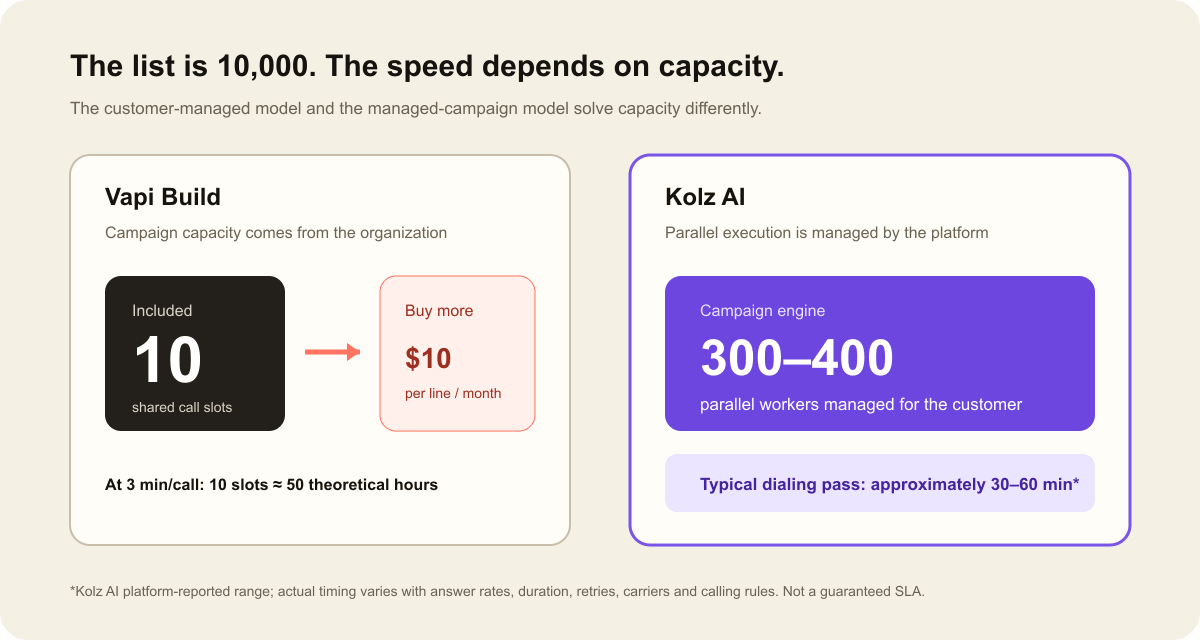
Kolz AI treats parallel execution as part of the product. Its campaign engine runs roughly 300–400 workers in parallel, and typical 10,000-contact campaigns can complete their dialing pass in approximately 30–60 minutes, depending on answer rates, call duration, retries, carrier conditions, and calling rules. The customer does not buy or configure individual call lines.
“Skip converted contacts” requires an integration
Vapi's email says contacts who already converted are skipped at dial time. The documentation shows how: an optional blocking campaign.predial webhook calls the customer's server before each dial, and that server must return { eligible: true | false }.
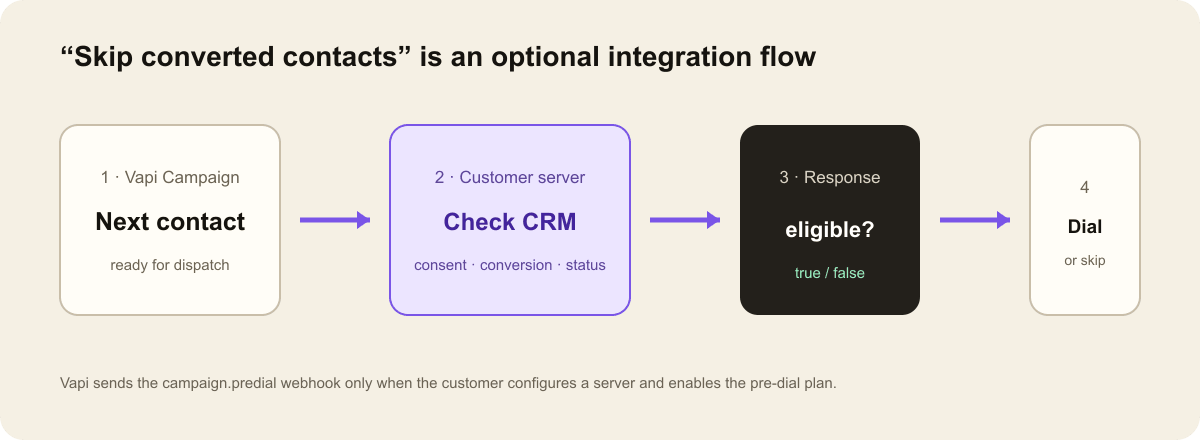
This is powerful for engineering teams with a live CRM or system of record. It is not automatic conversion awareness built into the uploaded CSV—the customer must supply and maintain the eligibility endpoint.
The lifecycle has another important detail: Vapi may retry contacts waiting for concurrency for up to one hour, or until the scheduled window closes. The campaign can still finish with failed, skipped, or pre-dial-failed contacts. We found no Campaigns documentation promising an automatic redial after a call fails mid-conversation.
What does the 10,000-call example cost?
Vapi does not publish separate Campaigns pricing. Its Campaigns docs point customers to the normal organization concurrency add-on, while its Build plan charges $0.05 per call minute plus the selected transport, transcription, model, and voice providers.
Using Vapi's calculator for 10,000 three-minute calls with Twilio outbound, Deepgram transcription, GPT-4o Mini with a 1,000-token prompt, and Deepgram voice produced a $2,545.27 usage estimate. Adding 90 call lines for 100 total concurrent calls adds $900/month, making the modeled month $3,445.27.
Kolz AI prices the same 30,000 minutes at $900 all-inclusive.
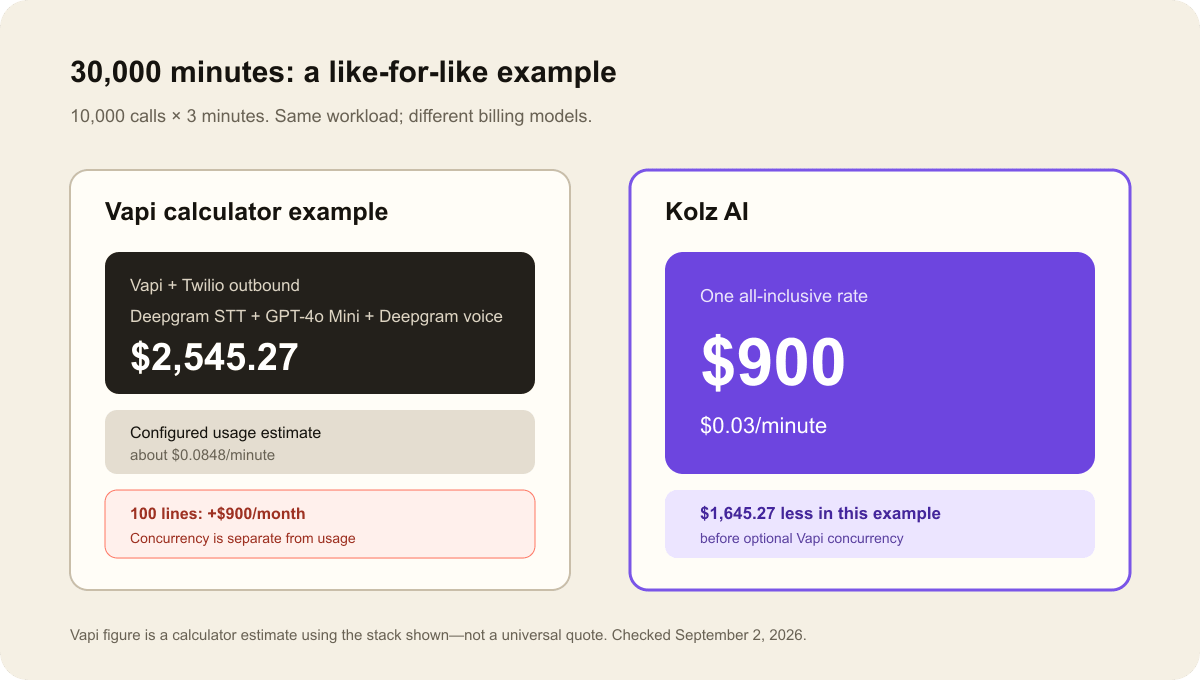
This is a reproducible scenario, not a universal Vapi quote. Provider choices, prompts, call durations, enterprise contracts, taxes, and optional products change the total.
A campaign should explain what happened
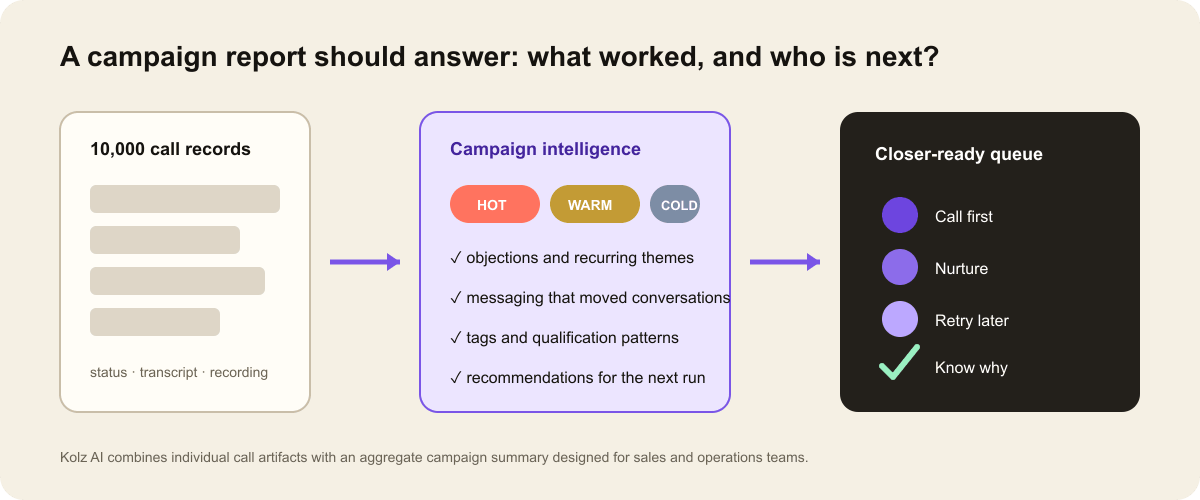
Vapi's documented campaign summary shows audience, remaining calls, connected calls, and pickup rate. Operators can open individual call records for cost, duration, recording, transcript, ended reason, and configured call analysis.
Kolz AI adds a campaign-level operating layer: detailed tags, Hot/Warm/Cold qualification, summaries, transcripts, recordings, objection patterns, and an explanation of what worked across the campaign. The deliverable is designed to tell the sales team who to call next—and the campaign owner what to improve next.
What campaign operators should evaluate
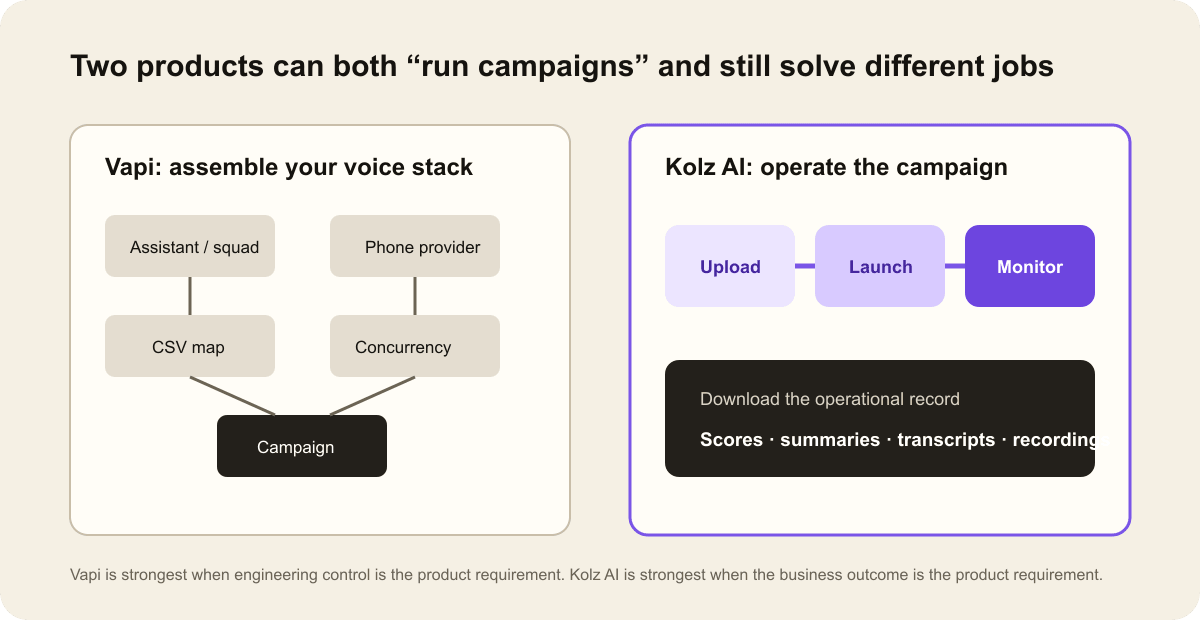
Vapi Campaigns is now a credible way for Vapi builders to dispatch a 10,000-contact list. Its advantages are configurability, assistants and squads, dynamic variables, webhooks, and developer control.
Kolz AI is built for a different buyer: a sales or operations team that wants managed parallel execution, one predictable price, and an aggregate campaign answer—not another infrastructure layer to configure.
The useful question is no longer, “Can it upload 10,000 contacts?” Both products can.
The useful questions are: How quickly will the campaign finish, who manages the capacity, what will the final bill be, and will the output tell the team what to do next?
Start with 100 free minutes at kolz.ai.
Sources and methodology: Vapi's Campaigns overview, Campaigns quickstart, scheduling and lifecycle guide, Campaign API reference, concurrency add-on guide, pricing, and cost methodology were checked September 2, 2026. Completion times are planning estimates. Kolz AI capacity and completion ranges are platform-reported operational figures, not guarantees. Vapi is a third-party trademark, and Kolz AI is not affiliated with Vapi.
Ready to try AI-powered calling?
See how Kolz AI can automate your outbound calls, qualify leads, and scale your customer outreach.
Test with 100 free minutes